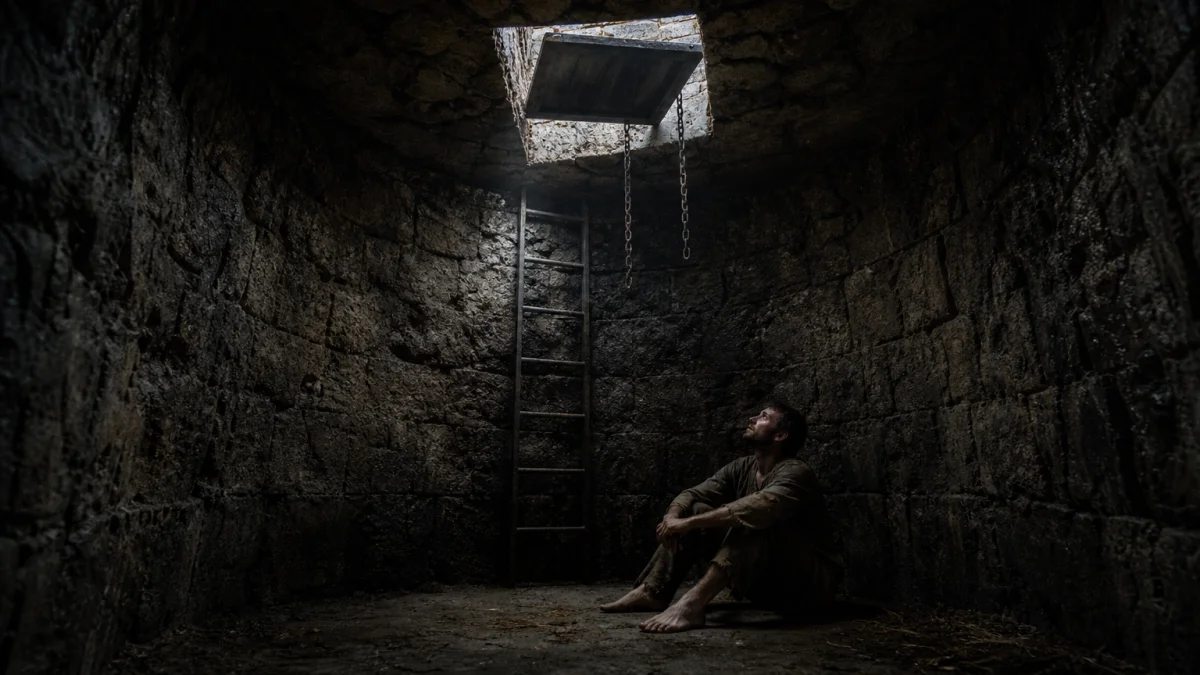
An oubliettea hidden prison cell entered and exited only from above is a type of dungeona dark underground room used for confining prisoners designed so a prisoner can only get in or out through a trapdoora door in a floor or ceiling that opens downward or upward above. The word is rare today and usually appears in historical writing, fantasy, or discussions of old prisons.
Reviewed with OpenAI Decisions. Assessment: accurate. Checked: 2026-10-24. AI assessment; not a guarantee of accuracy.
Pronunciation
AI-generated pronunciation audio (OpenAI).
Accent: General American English
IPA: /oob-lee-ET/
Easy pronunciation: oob-lee-ET (approximate spelling).
Stress: Stress the last syllable: ET.
Reviewed with OpenAI Decisions. Assessment: inaccurate — correction needed. Checked: 2026-10-24. AI assessment; not a guarantee of accuracy.
Oubliette Meaning
a deep prison room you can enter or leave only through a trapdoor above
Part of speech: noun
Definition: a dungeon with only a trapdoor in the ceiling as its entrance or exit
Example: The prisoner was thrown into a dark oubliette and left there for days.
Reviewed with OpenAI Decisions. Assessment: accurate. Checked: 2026-10-24. AI assessment; not a guarantee of accuracy.
Common Mistakes
- Do not use oubliette to mean any ordinary cellar, basement, or prison.
- It is more specific than 'dungeon' and refers to a particular kind of dungeon.
- The word is usually historical or literary, not common in everyday speech.
Reviewed with OpenAI Decisions. Assessment: accurate. Checked: 2026-10-24. AI assessment; not a guarantee of accuracy.
Frequently Asked Questions
What does oubliette mean?
An oubliette is a dungeon that can only be entered or left through a trapdoor in the ceiling.
Is oubliette the same as dungeon?
Not exactly. A dungeon is a general prison room, while an oubliette is a specific kind of dungeon with a trapdoor entrance or exit.
What part of speech is oubliette?
Oubliette is a noun.
Reviewed with OpenAI Decisions. Assessment: accurate. Checked: 2026-10-24. AI assessment; not a guarantee of accuracy.