Author: admin

  • Comparison meaning, definition, and synonyms

    Comparison is a noun that usually means the act of looking at two or more things to see how they are alikeSimilar to each other in one or more ways. or different. It can also mean the relationship between things when they are judged side by sideExamined together to understand their similarities and differences., or the state of being comparableSimilar enough to be meaningfully compared..

    Comparison meaning, definition, and synonyms

    Comparison Meaning

    looking at things side by side to see what is similar or different

    Part of speech: noun

    Definition: the act of examining two or more things to see how they are alike or different

    Example: The teacher asked the class to make a comparison between the two stories.

    Synonyms for this meaning:

    • comparing — A direct match for the act of examining similarities and differences.

    Other Meanings of Comparison

    Meaning 2

    being possible to compare

    Part of speech: noun

    Definition: the state of being comparable or able to be matched against something else

    Example: There was no comparison between the two films.

    Synonyms for this meaning:

    • comparability — Fits the idea of being able to be compared.
    • equivalence — Works only when the sense is about equal value or similarity, not general comparison.

    Meaning 3

    how two things relate when you compare them

    Part of speech: noun

    Definition: a relation based on similarities and differences

    Example: The study focuses on the comparison between urban and rural life.

    Synonyms for this meaning:

    • comparability — Can fit when the emphasis is on how things can be related by comparison, though it is less direct than the primary sense.

    Comparison Synonyms

    Similar Meaning

    • comparing

    the state of being comparable or able to be matched against something else

    • comparability
    • equivalence

    a relation based on similarities and differences

    • comparability

    Common Mistakes

    • Using compare as a noun synonym; it is usually a verb.
    • Using comparison to mean ‘similarity’ in general, when it more often refers to the act or process of comparing.

    Frequently Asked Questions

    What does comparison mean?

    Comparison means looking at two or more things side by side to see how they are alike or different. It can also refer to the relationship between things when they are judged this way.

    What is a simple synonym for comparison?

    A close synonym for the main sense is comparing.

    Is compare a synonym of comparison?

    Not usually. Compare is mainly a verb, while comparison is a noun.

  • Ecstatic: Meaning, Synonyms, and Examples

    Ecstatic describes a feeling of intenseVery strong or powerful. happiness, delightA feeling of great pleasure or happiness., or excitement. It is often used when someone receives wonderful news or experiences a moment of overwhelmingSo strong that it is difficult to contain or control. joy.

    Ecstatic after wonderful news

    Ecstatic Meaning

    Ecstatic is an adjective meaning extremely happy or delighted. It expresses a much stronger feeling than simply being pleased.

    Definition

    Feeling or expressing overwhelming happiness or delight.

    Ecstatic Synonyms

    Similar Meaning

    • Overjoyed — extremely happy about something.
    • Thrilled — very excited and pleased.
    • Elated — very happy and excited, especially after success or good news.
    • Delighted — very pleased; usually less intense than ecstatic.

    More Expressive Alternatives

    • Enraptured — filled with intense pleasure or delight, often while experiencing something captivating.
    • Rapturous — expressing great joy or enthusiasm, as in “rapturous applause.”
    • Jubilant — showing great happiness, especially when celebrating a success or victory.

    Ecstatic in a Sentence

    • He was ecstatic when he received the job offer.
    • She was ecstatic about her exam results.
    • We were ecstatic to hear that our team had won.
    • The announcement was greeted with ecstatic cheers from the crowd.

    Common Mistakes

    • Ecstatic is stronger than happy. Use it to emphasize intense joy. For ordinary satisfaction, “pleased” or “happy” may be more suitable.
    • Excited does not always mean ecstatic. Excitement can involve nervous anticipation, while ecstatic usually emphasizes great happiness or delight.
    • Rapt is not always an interchangeable synonym. It often means completely absorbed or attentive, as in “rapt attention,” without necessarily suggesting overwhelming happiness.

    Frequently Asked Questions

    What does ecstatic mean?

    Ecstatic means extremely happy or delighted. It describes a powerful feeling of joy, often caused by wonderful news or an exciting experience.

    What are synonyms for ecstatic?

    Close synonyms include overjoyed, thrilled, and elated. Enraptured, rapturous, and jubilant can also fit, depending on the context.

    How do you use ecstatic in a sentence?

    You could say, “He was ecstatic when he got the job offer.” Common patterns include “ecstatic about something,” “ecstatic to hear something,” and “ecstatic that something happened.”

    What is the difference between happy and ecstatic?

    Happy describes a broad range of positive feelings, from quiet satisfaction to strong joy. Ecstatic specifically describes an exceptionally intense feeling of happiness.

  • Careen: Meaning, Definition, Synonyms and Examples

    Careen usually means to move quickly in an uncontrolledNot being guided, managed, or kept under control. or unsteadyNot stable or balanced; likely to wobble or fall. way. It often describes a vehicle swervingChanging direction suddenly while moving. along a road or a person rushing forward while losing balance. It can also mean to lean or tiltTo move into a sloping position or lean to one side. to one side.

    Careen Meaning

    Careen means to move in an uncontrolled way, often while swaying, swerving, or tilting.

    Definition

    To move quickly and unsteadily, or to lean or tip to one side.

    Careen Synonyms

    Similar Meaning

    The closest synonym depends on the kind of movement being described.

    • Swerve — to change direction suddenly, especially while moving forward.
    • Lurch — to move suddenly and unsteadily.
    • Career — to move quickly in an uncontrolled way.

    Synonyms for Related Meanings

    When describing unsteady movement on foot:

    • Reel — to move unsteadily as if about to fall.
    • Stagger — to walk or move with difficulty keeping your balance.

    When describing leaning or swaying:

    • Tilt — to lean or move into a sloping position.
    • Sway — to move from side to side.
    • Wobble — to move unsteadily from side to side.

    Careen Sentence Examples

    • The car careened down the slippery road.
    • The shopping cart careened across the parking lot.
    • He careened around the corner and nearly knocked over a chair.
    • Without a clear plan, the project careened from one crisis to another.

    Common Mistakes

    • Assuming careen and career never overlap: As verbs, both can describe fast, uncontrolled movement. Career also has the familiar noun meaning of a person’s working life.
    • Using careen for any movement: The word generally suggests a loss of control, unsteadiness, or tilting. It is not a direct replacement for move or shift.
    • Treating all synonyms as interchangeable: Tilt emphasizes an angle, while swerve emphasizes a sudden change of direction.

    Frequently Asked Questions

    What does careen mean?

    Careen means to move quickly and unsteadily, often as if out of control. It can also mean to lean or tilt to one side.

    What are the best synonyms for careen?

    Swerve, lurch, and career are useful alternatives for uncontrolled movement. Reel or stagger may fit a person losing balance, while tilt fits the meaning of leaning to one side.

    How do you use careen as a verb?

    You can say, “The car careened down the hill.” The verb forms are careen, careens, careened, and careening.

    Can careen be used figuratively?

    Yes. It can describe a situation developing without control or clear direction. For example, “The project careened from one crisis to another.”

  • Signatory: Meaning, Definition, Synonyms and Examples

    A signatory is a person, organization, or country that signs a documentA written or digital record containing information., especially an agreementAn arrangement accepted by two or more people or groups. or treatyA formal agreement between countries.. The word is commonly used in formal, legal, and diplomaticRelating to official relations between countries..

    Signatory: Meaning, Definition, Synonyms and Examples photo

    Signatory Meaning

    Signatory means a person or entity that has signed a document, usually to express agreement with its terms.

    Definition

    A person, organization, or country that signs an agreement, treaty, or other official document.

    Signatory Synonyms

    Similar Meaning

    • Signer — a person who signs a document; a broader and less formal term.

    Signatory Sentence Examples

    • The country became a signatory to the treaty.
    • Each signatory received a copy of the agreement.
    • She is an authorized signatory for the company.

    Common Mistakes

    • Confusing signatory with signature: A signatory is the person or entity signing; a signature is the name or mark used to sign.
    • Using signatory in casual contexts: For someone signing a birthday card or an autograph, signer is usually more natural.
    • Using the wrong plural: The plural of signatory is signatories.

    Frequently Asked Questions

    What does signatory mean?

    A signatory is a person, organization, or country that has signed a document, especially an agreement or treaty.

    Is signatory the same as signer?

    The words are close in meaning. Signer is a general term for someone who signs, while signatory is more formal and typically refers to someone signing an official document.

    Can an organization be a signatory?

    Yes. A company, government, or other organization can be a signatory to an agreement, with an authorized representative signing on its behalf.

  • Futile: Meaning, Synonyms, and Examples

    Futile describes an effortThe energy or work you put into doing something. or action that produces no useful resultSomething that happens because of an action or event. or has little chance of succeeding. It is often used for attemptsActions taken to try to accomplish something. to achieve something when success seems impossibleUnable to happen or be achieved..

    Futile Meaning

    Futile is an adjective meaning ineffective or pointless because an action cannot achieve its intended result.

    Definition

    Producing no useful result; unlikely to succeed.

    A man pushing a massive boulder uphill, illustrating futile effort.

    Futile Synonyms

    Similar Meaning

    • Fruitless — producing no successful or useful result.
    • Vain — unsuccessful in achieving an intended purpose, as in “a vain attempt.”
    • Unavailing — failing to help or produce the desired effect.
    • Ineffectual — unable to produce the intended result.

    Less Common Alternatives

    • Bootless — an archaic or literary word meaning useless or unsuccessful.
    • Otiose — a formal word that can mean serving no useful purpose; it may also describe something unnecessary.

    Futile in a Sentence

    • We made a futile attempt to start the car with a dead battery.
    • It seemed futile to argue with someone who refused to listen.
    • All their efforts to save the damaged painting proved futile.

    Common Mistakes

    • Futile does not simply mean difficult. A difficult task may still succeed; a futile effort offers little or no prospect of achieving its goal.
    • Futile and meaningless are not always interchangeable. Futile focuses on a lack of results, while meaningless focuses on a lack of meaning or significance.
    • Use futile with efforts and actions. Common combinations include “a futile attempt,” “a futile effort,” and “futile resistance.”

    Frequently Asked Questions

    What does futile mean?

    Futile means unable or unlikely to produce a useful result. It describes an action or effort that cannot achieve its intended purpose.

    Is futile a negative word?

    Yes. Futile usually expresses a negative judgment about the usefulness or likely success of an action.

    What is a simple synonym for futile?

    Pointless is a simple alternative in many contexts. Fruitless is especially close when describing an effort or attempt that produces no result.

  • Sensitive Meaning, Definition, and Synonyms

    Sensitive is a word with several meanings in English. It can describe a person who is strongly affected by emotionsFeelings such as happiness, sadness, anger, or fear., a part of the body that hurts or reactsChanges or responds when something happens. easily, or something that responds quickly to touch, light, temperature, or other stimuliThings that cause a response in a person, organism, or device.. It can also refer to information that should be handled carefully or kept privateNot shared publicly or available to everyone..

    Sensitive Meaning

    Sensitive usually means easily affected by emotions, physical sensations, changes, or outside influences. When used about a person, it often describes someone who quickly notices other people’s feelings and reacts strongly to emotional situations.

    Definition

    Quick to notice, feel, or respond to emotions, physical sensations, changes, or the feelings and needs of other people.

    Sensitive Synonyms

    Similar Meaning

    • tender
    • emotional
    • responsive
    • receptive
    • susceptible
    • delicate

    Synonyms for Other Meanings

    Easily hurt or painful to touch

    • sore
    • tender
    • raw
    • painful
    • delicate

    Quick to react or detect changes

    • responsive
    • receptive
    • reactive
    • highly tuned

    Aware of other people’s feelings

    • considerate
    • understanding
    • empathetic
    • thoughtful
    • perceptive

    Private or requiring careful handling

    • confidential
    • private
    • delicate
    • restricted

    Examples of Sensitive in a Sentence

    • She is very sensitive to criticism.
    • My tooth is still sensitive after the dental treatment.
    • This camera has a highly sensitive light sensor.
    • He is sensitive to the feelings of other people.
    • The report contains sensitive information.
    • Some people have sensitive skin that reacts easily to cosmetics.

    Common Mistakes

    • Sensitive does not always mean emotional. It can also describe physical pain, technical responsiveness, privacy, or vulnerability.
    • Sensible and sensitive have different meanings. Sensible usually means practical or reasonable, while sensitive means easily affected or quick to notice and respond.
    • Do not assume that calling someone sensitive is always negative. In some contexts, it can suggest empathy, awareness, and consideration for others.
    • The correct synonym depends on the meaning. For example, sore may fit a sensitive tooth, while empathetic may fit a sensitive person.

    Frequently Asked Questions

    What is the meaning of sensitive?

    Sensitive means easily affected by emotions, physical sensations, changes, or outside influences. It can describe an emotional person, a painful body part, a responsive device, delicate information, or something that requires careful treatment.

    What are the synonyms of sensitive?

    Synonyms for sensitive depend on the context. Common alternatives include tender, emotional, responsive, receptive, delicate, susceptible, empathetic, and considerate.

    Is sensitive a positive or negative word?

    It can be either positive, negative, or neutral depending on the context. Calling someone sensitive may praise their empathy and awareness, but it can also suggest that they are easily hurt or strongly affected by criticism and difficult situations.

    What is the difference between sensitive and sensible?

    Sensitive means easily affected or quick to notice and react, while sensible usually means practical, reasonable, and showing good judgment. The two words look similar but are not interchangeable.

    Can sensitive describe a physical object or device?

    Yes. A device can be sensitive if it reacts to very small changes in light, pressure, movement, temperature, sound, or other stimuli. For example, a sensitive microphone can detect very quiet sounds.

  • Lama – Synonyms, Definitions, Antonyms and Sentence Examples

    Lama is a noun A noun is a word that names a person, place, thing, or idea. used for a spiritual teacher in Tibetan BuddhismTibetan Buddhism is a rich spiritual tradition combining Vajrayana tantric practices, Mahayana philosophy, and native Tibetan elements that arose in the 7th century. . Looking for lama synonyms, definitions, related words, or sentence examples? The lists below explain which alternatives fit and where their meanings differ.

    Definitions

    A lama is a Buddhist A person who follows the Buddhism tradition and practices the teachings of Siddhartha Gautama, known as the Buddha. spiritual teacher, particularly in the Tibetan tradition. The word also appears in religious titles such as Dalai Lama and Panchen Lama. A lama is not necessarily an ordained monk.

    Part of speech: noun. Plural: lamas.

    Synonyms

    Similar meaning

    The closest alternatives describe a teacher’s spiritualRelated to religious beliefs or a person’s inner life. role. Broader religious terms may fit a particular sentence, but they are not always interchangeableAble to be used in place of one another without changing the meaning. with lama.

    1. Tibetan Buddhist teacher — a precise descriptive alternative.
    2. Spiritual teacher — a broader expression that does not specify a tradition.
    3. Spiritual guide — emphasizes guidance in religious practice.
    4. Guru — a related term for a spiritual teacher.
    5. Buddhist monk — appropriate only when the lama is also a monk.
    6. Cleric — a broader religious designation.
    7. Buddhist priest — a loose description found in some English usage.

    Words such as friar, rector, vicar, and father confessor describe other religious roles. They should not normally replace lama.

    Antonyms

    Opposite meaning

    Lama has no exact everyday antonymA word that has the opposite meaning of another word.. The following words can express a contrastA difference between people, things, or ideas that becomes clear when they are compared. in particular contexts, rather than a direct opposite.

    • Layperson / layman — someone outside the clergy; this contrast has limits because some lamas are lay teachers.
    • Student / disciple — contrasts with the teacher’s role in a teaching relationship.
    • Secular — an adjective describing something nonreligious, not a direct noun replacement.

    Atheist is not a reliable antonym for lama: belief in a creator god and the role of a Buddhist teacher are different questions.

    Related Words

    Common usage

    • Tibetan Buddhism
    • Dalai Lama
    • Panchen Lama
    • Buddhist teachings
    • Meditation
    • Compassion
    • Monastery
    • Disciple

    Sentence Examples

    Proper usage in context

    These original examples show how to use lama in English:

    • The lama spoke to the students about compassion.
    • She asked her lama for guidance on meditation.
    • A visiting lama gave a public teaching at the Buddhist center.
    • The students listened carefully as the lama explained the text.
    • Several lamas attended the ceremony.

    Lama vs. Llama

    In ordinary English, lama refers to a religious teacher, while llama refers to the South American animal. They are not synonymsWords that have the same or nearly the same meaning.. The capitalizedWritten with the first letter in uppercase., italicized word Lama also occurs as a scientific genusA group of closely related species in the scientific classification of living things. name, which is a separate use.

    Compare: “The lama taught meditation.” / “The llama grazed in the field.”

  • Riled Up Meaning: Examples and Everyday Usage

    Quick answer

    “Riled up” means angry, annoyed, or emotionally stirred up. Someone who gets riled up is reacting strongly to something that bothers them. For example: “He got riled up over the referee’s decision.” This means the decision made him upset or angry.

    Common meanings and patterns

    ExpressionMeaning
    be riled upBe in an irritated or agitated state.
    get riled upBecome upset or angry.
    rile someone upMake someone upset or provoke a reaction.
    get all riled upBecome particularly worked up; “all” adds emphasis.

    How to use “riled up”

    Use get riled up when you describe someone’s reaction, and rile someone up when you describe what causes that reaction. Compare these two sentences:

    “Maya got riled up over the extra charge.”
    Maya became upset when she saw the charge.

    “The extra charge riled Maya up.”
    The charge caused Maya’s reaction.

    The expression is conversational. In a formal complaint, you might write “I was frustrated by the unexpected fee” instead of “The fee got me riled up.”

    Word type and grammar

    Rile up is a separable phrasal verb. With a noun, you can say “rile the fans up” or “rile up the fans.” With a pronoun, place it in the middle: “rile them up.”

    The verb forms are rile, riled, riled, and riling. In “She is riled up,” the phrase describes her emotional state.

    Examples in sentences

    ExampleWhat it means
    The missed call got the coach riled up.The coach was upset about the referee’s decision.
    I got riled up when my delivery was canceled again.The repeated cancellation frustrated me.
    His teasing riled his sister up.His teasing annoyed her.
    The customers were all riled up about the new fees.The customers were strongly upset about the fees.
    She was still riled up after the argument.She had not calmed down yet.
    He kept interrupting, which only riled me up more.His interruptions increased my irritation.

    Common combinations

    PatternExample
    riled up about somethingThey were riled up about the parking restrictions.
    riled up over somethingHe got riled up over a comment in the group chat.
    riled up by somethingShe was riled up by the unfair accusation.
    get someone riled upThat topic always gets my uncle riled up.

    “Riled up” vs. “worked up” vs. “angry”

    ExpressionTypical emphasisExample
    Riled upAgitation or irritation in reaction to something.The unfair penalty got him riled up.
    Worked upStrong emotion, which can include worry or excitement as well as anger.She got worked up worrying about the interview.
    AngryThe general feeling of anger, without emphasizing how it started.He was angry about the broken promise.

    For a positive feeling before a concert or celebration, excited or pumped up is usually clearer. “Riled up” can describe someone being stirred up, but readers often understand it as irritation or agitation.

    Common mistakes

    AvoidUse insteadWhy
    He got rile up.He got riled up.Use “riled” after “got” in this pattern.
    Don’t rile up him.Don’t rile him up.An object pronoun goes between “rile” and “up.”
    That is riling up me.That is riling me up.The same pronoun placement applies with “riling.”

    Mini practice

    Complete each sentence with rile, riled, or riling:

    1. He got ______ up over the last-minute change.
    2. They are trying to ______ her up.
    3. The constant interruptions are ______ me up.

    Answers: 1. riled   2. rile   3. riling

    Frequently asked questions

    What does “don’t get riled up” mean?

    It means “try not to get upset or angry.” Depending on the tone, it can sound reassuring or dismissive. If someone has a valid complaint, acknowledging it first may sound more considerate.

    Is “riled up” a swear word?

    No. The expression itself is not profanity. It describes an emotional reaction.

    Is “riled up” only used in Southern American English?

    No. You may encounter it in Southern speech, but it is not exclusive to the American South. General English dictionaries include the expression.

    What are some synonyms for “riled up”?

    Depending on the sentence, use annoyed, irritated, agitated, upset, or worked up. Choose the word that best matches the emotion and its intensity.

    Srp2Eng tip

    Remember the difference: “I got riled up” describes my reaction. “That riled me up” identifies what caused it.

    Dictionary references: Merriam-Webster: rile and Cambridge Dictionary: rile. Examples and practice sentences on this page were written for this article.

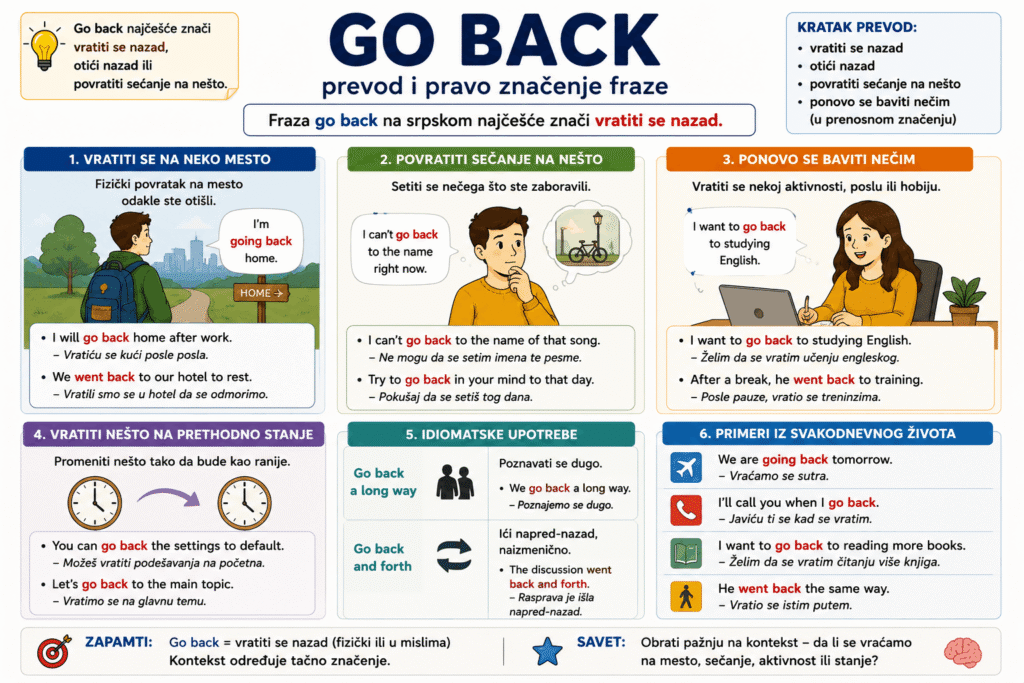
  • Go back – prevod i pravo znacenje fraze

    Kratak prevod: Vratiti se (na mesto gde govornik trenutno nije).

    Go back - prevod slika

    5 primera:

    1. It’s time to go back to the office. (Vreme je da se vratim u kancelariju.)
    2. She decided to go back to school. (Odlučila je da se vrati u školu.)
    3. We should go back and check. (Treba da se vratimo i proverimo.)
    4. Don’t go back on your word. (Ne pogazi svoju reč.)
    5. He went back to his hometown. (Vratio se u svoj rodni grad.)

    Najčešća greška: Mešanje sa come back – koristi go back kada se udaljavaš od trenutne lokacije.

    Slična fraza: Return (formalnija zamena).

    Kratak zaključak: Go back označava kretanje nazad ka nekoj lokaciji gde nisi sada.

    Isprobaj srpsko-engleski prevodilac:

    Prevodjenje Reci EN-SR

    Unesite englesku ili srpsku rec koju zelite da prevedete.

    Smer prevoda

    Pomaze kada rec ima vise znacenja.

    Ovde mozete navesti dodatna pojasnjenja za tacniji prevod.


    Vezbaj Izgovor

    Vezbaj Spelovanje

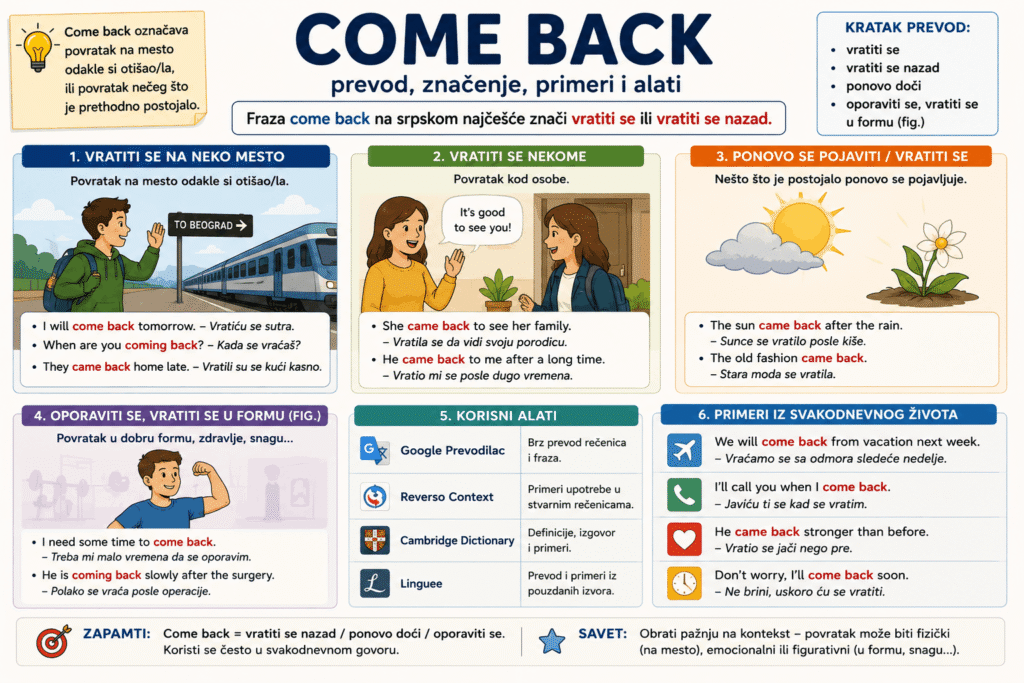
  • Come back – prevod, primeri i alati

    Kratak prevod: Vratiti se (na mesto gde je govornik).

    5 primera:

    1. He will come back home soon. (Vratiće se kući uskoro.)
    2. When did you come back from work? (Kada si se vratio s posla?)
    3. They came back to the hotel. (Vratili su se u hotel.)
    4. I hope she comes back tomorrow. (Nadam se da se vraća sutra.)
    5. Don’t worry, I’ll come back quickly. (Ne brini, vratiću se brzo.)

    Najčešća greška: Upotreba „return back“ (pleonazam, jer return već znači vratiti se).

    Slična fraza: Go back (znači vratiti se negde gde govornik trenutno nije).

    Kratak zaključak: Come back se koristi za dolazak ka govorniku ili mestu gde je govornik.

    Isprobaj srpsko-engleski prevodilac:

    Prevodjenje Reci EN-SR

    Unesite englesku ili srpsku rec koju zelite da prevedete.

    Smer prevoda

    Pomaze kada rec ima vise znacenja.

    Ovde mozete navesti dodatna pojasnjenja za tacniji prevod.